Movement Within the Current

The Invitation

Somewhere along the way, I learned that surviving isn’t always about getting stronger.

Sometimes it’s about getting softer.

Not softer in conviction. Softer in posture. Softer in the way you meet the world when it rushes at you faster than you can possibly keep up.

One of the first books I was ever genuinely excited about during my teenage years, was the Tao Te Ching.

Not because it was assigned. It was a gift. I didn’t understand most of it then. But I remember how it felt to hold it.

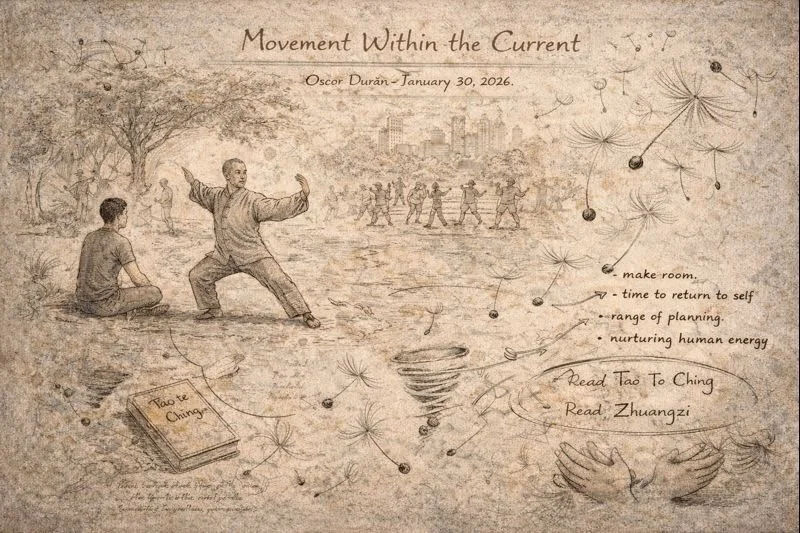
It was my first trip to Manhattan. Shoot it was actually my first time in New York. It was the summer after my High School Junior year. I was exploring Central park, and somewhere in that maze of peace, I found this semi-open shaded grove. A loose circle of people were gathered there, not under a big tree exactly, but tucked into this little pocket of light and shadow.

In the middle of it was an older man, moving. Not fast. Not forcefully. Just deliberately. Softly. Like he wasn’t performing for anyone at all.

I didn’t walk up close. Instead, I sat under one of the nearby trees. Not close enough to distract. But close enough to try to catch a few words. The distance made it difficult. His voice didn’t really carry, so I just watched.

I watch how some of the students were trying to follow and learn his movements. I could tell a small handful of students, had been here before. Their eyes were closed as they moved through their forms. Forms that were part of their souls.

I ended up staying for the whole session, probably forty minutes. I didn’t realize how still I had become until it was over.

When they finished, and after the last student left, I finally walked over. I remember giving a small, semi awkward bow as I really didn’t know if that was appropriate to the culture he came from. But I knew it was something I had been taught in martial arts. And it felt right.

I was so excited to thank him for his lesson. He smiled and said he saw me under the tree. He asked me what I learned, and what I knew before I came.

I told him I had learned about movement and peace watching them. About being part of nature. Then proceeded to share my novel knowledge of Hakdari Seogi & Juchum Seogi, how to posture your body to breathe. These had been two of the core teachings in my years of Taekwondo. At least two of the ones I could put into words to match what I seen that day.

I shared I had trained, for a time, under Master Chul Koo Yoon of Indianapolis, a grand master of the Korean Tae Kwon Do Academy.

He smiled, and nodded.

Then invited me to sit, and proceeded to offer me one short lesson.

It was small. Quiet. Almost nothing you would notice from the outside. But, my how this moment would live with me the rest of life.

The Lesson

The kind man, walked less than five feet from where I sat down. He took this deep focused breath, and as he exhaled, he proceeded to show me…

Where to place my weight.
How to soften my shoulders.
How to let my breath fall lower in my body instead of lifting in my chest.

After the lesson, I thanked him so much. I ask him what I could read if I wanted to understand more about this. More about its essence.

He walked over to this little brown leather bag.

Reached inside.

And pulled out a small book, and handed it to me.

A gift for you, he said with a smile.

It was called, The Tao Te Ching.

The Tao Te Ching still feels like coming back to that shelf.

It isn’t a book about how to fix the world. It’s a book about how the world already moves.

About softness.
About patience.
About not forcing.
About water.

About how enormous forces can be met, not with resistance, but with attention.

This has been quietly sitting in the back of my mind for years in my community development work.

But it’s not only how I see our work. It’s how I try to see the world.

When I think about young people leaving our communities. When I think about how many families are told, over and over, that housing is the only real way to build wealth. When I think about how there will always be people who want to take more than they need. And how there will always be others who are far stronger than you.

I don’t read those as failures anymore.

I read these as mere forces.

Currents.

Human movement.

I remember how much I was thinking about all of this before I chaired my very first neighborhood meeting with my Deer Park family.

I was nervous. Really nervous. Those meetings ran long. I never complained, well, not out loud, but damn… they were long.

They started at 7:00 pm and usually ran until about 9:10. Every evening, of the second Wednesday of the month, I would watch people quietly slip out early. By the end, everyone was ready to go home to their loved ones.

And I kept wondering: What if we are working against people’s natural energy instead of with it?

That night, when it was my turn to bring something new forward, I asked a simple question.

Would it be okay if we tried something different?

Would it be okay if we kept the meeting to fifty minutes?

I was holding the book in my hand.

The Tao Te Ching.

The one the man in the park had handed to me.

I told my mentors, my friends, briefly, about the teaching.

About not forcing. About movement. About how sometimes the way you create more energy in a room is not by asking people to stay longer…

…but by giving them their time back.

I told them I had this small idea.

That if we made the meeting intentionally shorter, just a little too short, people might actually stay afterward. Not because they were obligated. But because they wanted to. Because they still had energy. Because they still had breath. Because they hadn’t been drained by process.

They loved it. They smiled. And I remember how early and excited I sounded as I tried to explain what this little book had been teaching me.

That moment changed something for me. Not because the idea was revolutionary. But because it worked. And it confirmed something I had been slowly learning: We don’t need to fight human nature. We need to design for it.

We don’t need to outmuscle the strongest forces in the room. We need to understand where they are already moving, and then shape the space around that movement.

That is how I try to do community work now.

And honestly…

that is how I try to move through the world.

Because here’s the honest truth:

We are never going to stop the human drive to strive, to build, to grow, to take, to compete.

We are never going to stop Capitalism or Globalization from moving.

We are never going to stop young people from wanting to leave, explore, adventure, wander, and test the edges of their own lives.

That energy is not a problem.

It is a current.

And the older I get, the more I believe this:

Community work is not about fighting currents.

It is about learning how to stand inside them.

The Tao talks about acting without forcing.

Not because force is bad.

But because force is often wasted on things that were never meant to be stopped.

The Truth

As I prepared to leave the park that day, the kind man bowed to me and thanked me for waiting and sharing. I returned the bow and thanked him for the gift.

Today I now realize, that day, I was gifted more than a mere text, I was given a path to courage.

Not strength. Not dominance. Learning how to focus. Learning how to center. Learning how to breathe into your chest and your diaphragm when everything in you wants to tighten.
Learning how to clear your mind.

How to stay calm. How to sit calm.

Even when the situation itself is not calm at all, and when it is that Massive force of strength lay right in front, preparing to put you in your place.

The Share

So if you’re curious about this frame of thought, and are preparing to wander through your community filled with the large heavy and daunting challenges, I’d start here.

Read the Tao Te Ching.

Read a few short chapters at a time.

Let it be slow.

Then, if you find yourself wanting something more playful, more human, more strange and beautiful…

I later found the Zhuangzi.

It’s full of stories. Absurd little truths. Gentle rebellion against being trapped by roles and labels.

And if you’re someone who likes to feel ideas in your body, not just your head…

These Tai Chi foundational texts are where philosophy becomes posture. Where listening comes before action.

Where four ounces, can actually redirect a thousand pounds.

I don’t think community development is actually about programs. Its not even about housing, or money.

It’s about movement.

Of trust.
Of courage.
Of imagination.
Of people deciding, quietly, that they’re allowed to step forward.

Not learning how to push harder.

But learning how to yield with purpose.

How to turn gently and focus your actions, Focus that will prepare you to have the courage to stand before 1000 pounds and not back down.

How to let the river keep being a river, and still help people cross.

Thank you for reading and for the great work you are doing in your own community.

This codex, is part of a larger work that will be embodied in my first text which is seeking to help move all our communities forward together.

The Garden Regions of Tomorrow: Reviving our Civic Imagination, is scheduled for released June 1, 2026.

More from the Codex

  • Loading…

A Glimpse into "The State of Us"

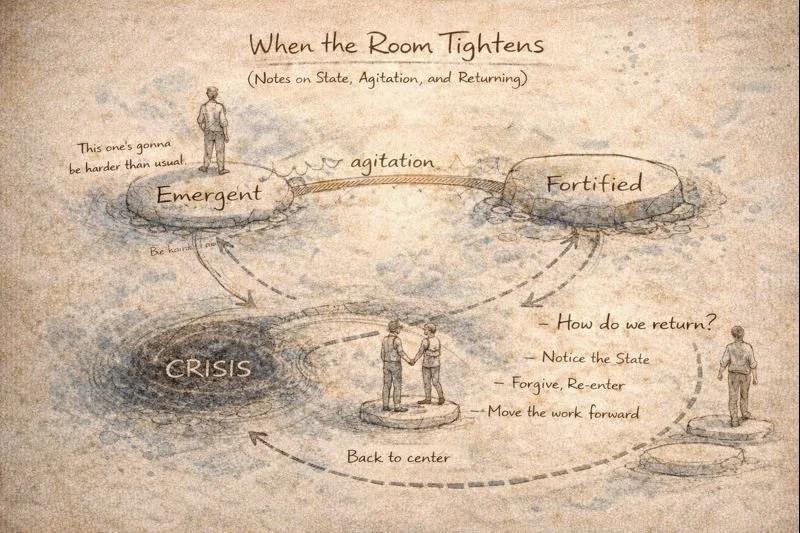
When the Room Tightens

(Notes on State, Agitation, and Returning)

Man, We’ve all been there.

That moment when you walk into a room and you can feel it, way before anyone says a word. Its almost like time slows down. Nothing has happened yet. No sharp exchange. No visible conflict. And still, your body knows.

This one’s gonna be harder than usual.

It’s not fear. It’s not even anticipation. It’s a subtle tightening. A density in the air. Like the room itself has already leaned forward.

Everyone knows this feeling. We just rarely name it.

I have come to understand that, States arrives way before words.

It enters fixed on every being and partnership cluster who enters a room, whether they choose to speak or not.

Looking back on last week’s meeting, that stayed with me long after it ended, I don’t think what mattered most was anything that was said. I mean, it was rough, lots of things said that sting even weeks later, and I did my share of agitation and word vomit.

If this feels familiar, or if you happen to be living it right now, try not to worry, and please don’t beat yourself up like I have all week.

These meetings matter, the words spoken are essential, however, the real work in community building is to understand what States of Us, were/are present during and after the exchange.

What I have come to learn is that the State of Us fluctuates throughout the day and varies by environment.

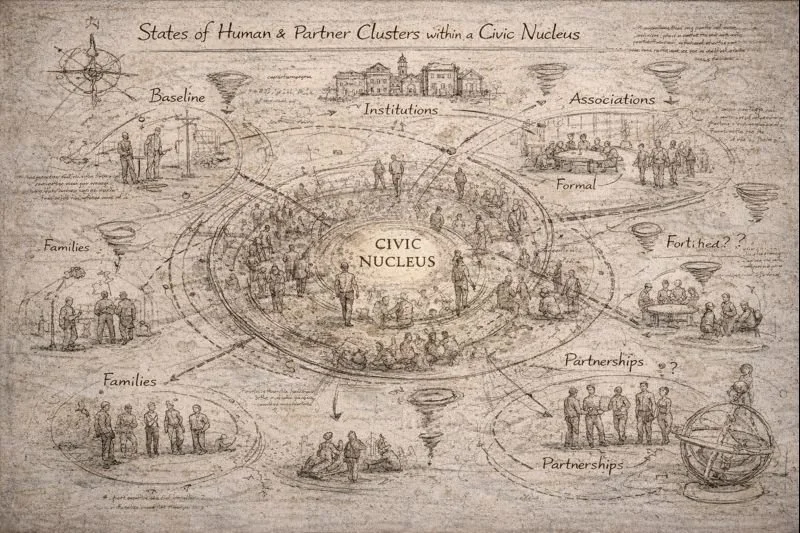
Individuals have States. Rooms have states. Partnership clusters have states.

These universal states emerge between us, through posture, pacing, silence, tone, history. Once a state is present, it shapes everything that follows: how comments land, how pauses are interpreted, how quickly things escalate or stall.

This isn’t psychology.

It’s physics.

From Generative to Crisis

I seem to spend a lot of time in the exhausting Generative state, by default. That’s where I do my best work, curious, exploratory, building outward with others.

But this room didn’t offer much to imagination, and at a certain point thats was true from both sides.

My system adapted. Not into collapse, I have done this too long. I moved directly into the Crisis state.

The Crisis state, I like to call the battle state, it is a type of holding state. It narrows focus and fortifies attention, not to win, but to stabilize. It shows up when stakes feel high and responsibility feels real. It’s less about persuasion and more about keeping the work from slipping.

States have both positives and negatives depending on our environments.

It is not always dramatic.

It’s not always precise. But it is Contained.

And in the case of the Crisis/Battle state, we are braced and fortified.

The Crisis state is expensive. As of now, I feel it may be the most taxing of all six states, as its effects stay with you “for a minute”. This is 90’s US semi hood slang for, an overly long duration of time. : )

Agitation as Movement

Here’s something I didn’t fully understand until this year:

There are three methods of state exchange I have identified, Agitation, Stimulation, and Attenuation. Energy moves and really doesn't stop.

Now here is hard part, Agitation isn’t harm. It’s a form of stimulation. It’s contact. It’s friction revealing where things are tight, misaligned, or unresolved. In living systems, Agitation often precedes change.

We tend to treat these moments as failures of professionalism or communication. We call them interpersonal issues and move on. And way too many times these misspoken or misinterpreted words, Fortify Us and eventually this individual Fortified state, is anchored and institutionalized to our partnership cluster and thus so too the programs and initiatives of the community.

Meanwhile, we’re trying to coordinate institutions. Build housing. Align systems with real human consequences.

The truth is quieter and harder:

You can have excellent policy, strong institutions, and clean processes, and still experience jams, if the human energy inside the system has nowhere to go.

Why Blame Doesn’t Help

It’s tempting, in moments like these, to replay the meeting looking for fault. Who started it. Who misread whom. Who brought what into the room.

That instinct is understandable.

It’s also unhelpful. Highly unhelpful. Blame is the ultimate enemy to our work!

Blame freezes the system. It locks attention backward. It turns a living interaction into a static story.

What actually helps is something simpler and more demanding:

State awareness without judgment.

What state was present?

What did it do to the room?

What did it cost?

And, most importantly, how do we return?

The Work Happens After

Here’s the part we don’t design for nearly enough:

You cannot control the State of any individual human. At the individual level we never truly know what someone is thinking feeling and carrying with them.

States arise. They take the wheel.

The ethical work happens after. After the meeting. After the Fortification.

After the agitation has done its work.

Can we notice the state we were in without shaming it?

Can we forgive ourselves and each other for being human under pressure?

Can we re-enter the work without pretending nothing happened?

If systems require perfect performance, they will fail.

If partnerships can’t survive a hard meeting, they won’t survive real work.

A Note for the Larger Theory

We’ve misdiagnosed the housing crisis, not because units and policy don’t matter (they do, deeply), but because we’ve left people out of the original equation.

Not people as numbers.

People as states.

Imagination doesn’t enter systems through spreadsheets alone. It enters through humans who feel safe enough, steady enough, and seen enough to stay engaged, even after tension.

The work of a Revitalist isn’t to control rooms or manage personalities.

It’s to cultivate conditions where return is possible.

Notes from the Field

That meeting didn’t resolve everything. It also didn’t break anything. What it did was reveal something real about how systems move, and how they stall.

Sometimes the work isn’t about smoothing the surface. Sometimes it’s about letting the water churn long enough to find a new channel.

No blame. No villains.

Just weather, movement, and the ongoing practice of coming back together.

That’s the work.

Thank you for reading and for the great work you are doing in your own community.

This codex, is part of a larger work that will be embodied in my first text which is seeking to help move all our communities forward together.

The Garden Regions of Tomorrow: Reviving our Civic Imagination, is scheduled for released June 1, 2026.

More from the Codex

  • Loading…

Systems Housing: Works for Us

Housing is one of the few topics where the word you use can end the conversation before it starts.

Say low income housing, and people picture a certain kind of building, a certain kind of neighborhood, a certain kind of outcome, whether that picture is accurate or not.

Say social housing, and in the United States the reaction is often immediate. For many, the word doesn’t land as housing at all. It lands as socialism. Anti-American. Government overreach. The conversation shifts from design to ideology in about half a milli second.

This isn’t a judgment.
It’s just how language works.

The same thing happens with affordable housing, workforce housing, and a half dozen other terms. Each word carries baggage. Each triggers assumptions. And once those assumptions kick in, people stop listening for what’s actually being proposed.

What’s interesting is that these reactions usually have very little to do with the housing itself.

They’re reactions to categories, not to function.

That’s where this theory begins.

The International Headline

All over the world, housing is the headline problem right now. Different countries use different languages, but the pressure looks the same. Costs are up. Access is down. Everyone feels it.

What the evidence consistently shows is simple: housing outcomes are shaped by how many homes exist, where they are, and who can realistically access them. When usable housing doesn’t line up with real demand, costs rise. When access is constrained, by price, location, timing, or eligibility, instability follows. These patterns appear across very different national and regional contexts.

China offers a striking example of this. Over the past decade, journalists and researchers have documented what are often called “ghost cities”, entire districts built at massive scale, with housing stock that sits largely empty. Estimates cited by outlets such as The Economist and Reuters suggest tens of millions of vacant units across the country. On paper, this looks like a supply success.

At the same time, scholars studying internal migration and housing access, including Dr. Kam Wing Chan of the University of Washington, have shown that large segments of the population still struggle to secure stable shelter. The issue is not simply whether housing units exist, but whether people can access it in a way that fits their lives, work, and mobility. The result is a paradox: millions of empty homes alongside millions of people living in insecure or temporary conditions.

The United States presents a different picture, but many of the underlying pressures are familiar.

By global standards, the U.S. is resource-rich. The country has extensive housing stock, mature financial markets, and a long history of residential development. Yet the data show sustained strain. Roughly one in three U.S. households is housing-cost burdened, spending more than 30 percent of income on housing. In many regions, housing costs have grown faster than wages for years, placing increasing pressure on middle-income households as well as lower-income ones.

This stress is not confined to any single policy environment or region. My work has gifted me front row vantage points of this battle in our communities of all sizes and personalities. It appears in cities and rural areas, in fast-growing markets and slow-growth communities alike. Despite decades of reforms, programs, incentives, and regulatory changes, the pressure persists.

That persistence suggests something important: policy alone is not the issue.

This does not mean policy not new units is irrelevant. It means that neither of these intervening variables build a conclusive equation to truly get to root issues. My first hand experience Housing has been treated primarily as a standalone sector, when in practice it functions as a critical component of multiple systems, labor, education, healthcare, infrastructure, and community life.

When those systems depend on people being able to arrive, stay, move, and return, housing quietly becomes the hinge point. If that hinge is misaligned, pressure shows up everywhere else.

That is why expanding the frame matters.

Instead of starting with units or programs alone, it becomes logical to expand to focus on the systems themselves, and to ask what role “housing” needs to play inside them for communities to function over time.

That is the starting place for Systems Housing.

Meanwhile, in another fractured corner of the community development world, a different question keeps surfacing, quietly, persistently, in places that otherwise look healthy:

Where did everyone go?

Schools can’t fill classrooms.
Hospitals rely on short-term staff.
Utilities struggle to recruit operators.
Local governments can’t staff basic roles.

These are usually described as workforce problems. Pipeline problems. Training problems.

But they keep showing up in places that want people.

That tension has been explored for years by scholars studying labor, migration, and regional development. Dr. Enrico Moretti, for example, has written about how talent increasingly concentrates in certain regions while other places struggle to retain or attract workers, even when jobs exist. His work makes clear that people don’t just move for wages. They move for ecosystems.

Similarly, Dr. Raj Chetty’s, and may I say a super hero to me in many ways, research on economic mobility has shown how place matters deeply, not just in terms of opportunity, but in whether people can realistically stay long enough to benefit from it. Mobility isn’t only about income. It’s about whether a system supports people through the fragile early stages of work and life transitions.

And look, I see you nodding your head, in case you want to geek out a little too, I added links to his current papers and talks. If you ditch this piece fir him, I get it.

But either way, if you are not sure what to read (or watch) first, my personal favorites are:

The Designing Connected Communities to Provide Pathways out of Poverty (2023) lecture, and of course Race and Economic Opportunity in the United States: An Intergenerational Perspective (2019), this one carries that little extra emotional & historical umph.

Closer to the ground, community development thinkers like Margaret Wheatley and John McKnight have long pointed out that systems weaken when people feel interchangeable or transient. When communities lose continuity, when everyone is always “just passing through”, institutions begin compensating with contracts, overtime, and short-term fixes. The work still gets done, but at a higher cost and with less soul.

What’s often missing from these conversations is housing, not as a standalone problem, but as connective tissue.

The question isn’t why people leave. Leaving is normal. Curiosity is healthy.

The harder question is why arriving, or returning, has become so risky.

That risk shows up most clearly at the beginning:

  • the first job after school

  • the first year in a new town

  • the moment someone considers coming back with skills they’ve learned elsewhere

This is when people decide whether to commit or keep an exit plan.

And yet, this is exactly where housing systems tend to be the least flexible, the least coordinated, and the least forgiving.

When housing doesn’t line up with work, timing, and movement, every other system pays the price.

That’s not a workforce failure.
It’s a systems misalignment.

And it’s the opening Systems Housing is trying to address.

So now, lets play!

Just Imagine…

What if, instead of treating these as separate crises, we see how they overlap, and then use a singular approach?

What questions or ideas jump to your mind?

In effort to move these ideas forward, I first had to frame down to a simpler segment of the question:

What job is “housing” actually doing inside the system?

Housing sits at the center of this moment, not just as a cost or a shortage, but as a pressure point where multiple systems begin to strain at once.

It’s important to say this plainly: young people leaving, creatives, tech workers, skilled professionals, is not the problem. I mean, it’s not great. If in mass, it is a signal that something in a community’s system is backed up somewhere. But leaving itself isn’t a failure.

Most people want to leave at some point. They want to explore, try something new, see the world. Leaving is part of becoming. Its part of the human experience.

The real problem is how hard it has become to arrive somewhere new, or return home, without taking on enormous risk.

That risk shows up most clearly at the beginning.

  • the first job after school

  • the first move to a new place

  • the decision to come back and try again

  • the first year or two of seeing whether something might work

This is when people are open, curious, and willing to experiment.

It’s also when housing is usually the most expensive, least stable, and least coordinated part of the experience.

That’s not because anyone failed.
It’s because housing was never designed for this job.

What Our Current Housing Tools Already Do

Most housing tools are built for permanence. Specially in relation to the focus of the qualified people served.

Public housing.
LIHTC.
Market-rate development responding to demand.

All of these matter types matter deeply. None of them are wrong.

They’re just doing different jobs. Different Area Median Incomes foci.

What’s been missing is housing designed for transition and system function.

That’s what Systems Housing names.                         

Systems Housing
An expansion of housing tools within a community that complements subsidized housing tools, by deliberately positioning housing as infrastructure investments, to staff, stabilize, and sustain essential civic, public, and community-priority system team members.

A key clarification (this matters)

Systems Housing does not require building special or separate housing, it can of course include new units, but must work with exiting market.

In most cases, these units already exist,  or are already being built.

Systems Housing works by aligning existing development with system needs.

That alignment can include:

  • participation from market-rate and affordable developers

  • threshold set-asides or unit commitments

  • bonus incentives or zoning flexibility

  • rent guarantees or master leasing

  • PBV-style certainty that reduces developer risk

From the developer’s perspective, this looks familiar: predictable rents, lower vacancy risk, faster absorption.

From the resident’s perspective, housing feels accessible,  sometimes deeply affordable.

But from the system’s perspective, this is not a subsidy to a person, nor one tied to AMI constraints.

It is an infrastructure investment.

The unit is serving a function inside the system.

Purpose, not income

Access to Systems Housing is not primarily about income.

It’s about purpose.

People are selected because of the civic or community-serving roles they are stepping into or preparing for:

  • teachers

  • electricians

  • lineworkers

  • nurses

  • utility operators

  • public administrators

  • other public- and community-facing roles

This is how the military treats housing in the US, not as charity, but as mission-critical infrastructure.

Systems Housing applies that same logic to civilian civic life and community development strategies.

A very human example

Say a community realizes it needs electricians. And I hear this one a bit.

Not someday.
Now.

The work is there. The infrastructure depends on it.

So the community partners with institutions in the existing system, such as the IBEW. Training is visible and supported. And Systems Housing units, already part of existing developments, are made available.

Not forever.
Not randomly.
With intention.

Now a young person doesn’t just see a job posting.

They see a path:

  • training

  • housing

  • stability

  • people who know your name

That’s what many young people are actually leaving to find.

Systems Housing lowers the fear at the moment it matters most.

It doesn’t say stay forever.
It says jump in here.

Time-limited by design

Systems Housing is typically time-limited, often one to three years.

Long enough to arrive.
Long enough to learn.
Long enough to decide what comes next.

After that, people move on, or stay, without being trapped.

Movement is the feature, not the failure.

Scale belongs to the community

The scale of Systems Housing is not fixed.

Some communities may only need a handful of units. Others may choose to invest more heavily. That choice belongs to the community because the goal isn’t a number, it’s function.

This is about maximizing and aligning dollars already being spent.

Which brings us to budgets.

The part we usually avoid and where most community dreams die.

Systems Housing only works if this portion of the existing housing ecosystem, is treated as part of the systems that depend on people:

  • schools

  • healthcare

  • public safety

  • utilities

  • local government

Not because housing is their job, but because instability already shows up in their budgets as churn, vacancies, overtime, and constant restart.

Systems Housing doesn’t add a new cost.

It reorganizes an existing one.

What changes when this layer exists

When Systems Housing is in place:

  • civic and public service roles are supported structurally

  • young people try without fear

  • returning home becomes realistic

  • developers gain certainty

  • budgets reinforce each other

  • housing does more than one job

Public housing and LIHTC continue their essential long-term work. Market-rate housing continues to matter.

Systems Housing doesn’t replace any of that.

It fills a missing layer.

And when that layer exists, “where did everyone go?” stops sounding like a mystery, and starts sounding like a design problem we finally know how to solve.

That’s the idea behind Systems Housing.


Thank you for reading and for the great work you are doing in your own community.

This codex, is part of a larger work that will be embodied in my first text which is seeking to help move all our communities forward together.

The Garden Regions of Tomorrow: Reviving our Civic Imagination, is scheduled for released June 1, 2026.

More from the Codex

  • Loading…

The Independent Variable

A Working Theory of the "Us"

I have spent nearly 18 years working in my regional community as an applied social researcher. Serving through public, private, social, municipal, and non profit institutions and associations, has been a true blessing. After all this time, I can honestly say I have found a sense of belonging I never knew was possible.

Now, I love community work, but to those who know me best, know I actually have a variety of “expressions”. At my heart, I am really just a maker. I love imagining an idea, sketching it out in one of my notebooks, and ultimately executing the idea into something tangible. It is truly one of those most joyous parts of life.

And wether I am making a custom garment for one of my clients, or working with a community or neighbor to do something dope in the neighborhood, or even just playing legos with my kids, in my mind, I am doing always doing the exact same thing.

I am using my imagination, trying to have fun, and building something wonderful with a brother or sister. And usually taking way too long to do it.

One of my primary areas of study, is developing my skills as a tailor and clothing designer. And its here that I feel lies a perfect analogy for how I have come to see community work.

I like to see the world in threads. I see how pieces are constructed, where the seams are weak, and how a beautiful garment is built one stitch at a time. This perspective has led me to a realization that isn't in the textbooks: the very fabric of how we build our communities is being sewn with the wrong thread.

When we look at the big picture, the macro level of our world, everything feels heavy, dark, and daunting. We feel like simple individuals can’t make a difference. But I believe that’s just a trick of scale. We are looking at a picture so big, that we can't see the fibers.

So here lies the root of this codex. When we look closer, with our tailors eye, around the big picture, down to our micro communities, our Garden Regions, we will find a critical math error that has stalled our progress as civilization for over a century.

In the social sector, we live by the "Primary Metric." We track "Families Served" like a scoreboard. We look at those numbers to tell us if a program is successful, but I have finally realized, that’s looking at the wrong end of the telescope.

"Families Served" is the outcome of the equation and its not even in the actual equation; it’s just the outcome! What?

When I finally saw this, I couldn’t unsee it. The current system operates on a broken logic: Policy + Units = People Served (People). In this formula, the human is the product at the end of a manufacturing line.

But simple physics says a result cannot be more complex than its input. You cannot "produce" a “person served”, if “person” wasn’t originally in your equation. So what this means is, “People” must return as a variable to the equation we all have been trying to understand for over a century.

It’s wild, really! I mean, I can’t believe it still. As a social scientist, shoot, as a community advocate, I have, like many across the world, been hunting for that main variable. I’ve been hunting for that missing thing that can help us move social challenges forward best.

We’ve all been trying to understand which variable is the most essential, or which combination of variables we’re missing. We think the staff are wrong. We think the people are wrong. We think we just need to train them differently, get new ones. But regardless of policy, units, leadership changes, workforce shifts, or training, things in our civilization appear to be swinging for the worse, well at least for the bottom 90-95% of the world that is.

Holy buckets!!!

I realized we have misdiagnosed the crisis. We spend so much energy on the "Units" and the "Policies," but those are dependent variables. They cannot move if the lead variable is stuck.

The piece we’ve been missing isn’t a new program; it’s the realization that the Independent Variable is actually “Us.” People, and more specifically, the “State of Us.”

This isn't just about math; it's about a state of matter. We’ve been trying to build the future with a neutralized variable because we’ve forgotten to look at the person in the mirror and standing right next to us.

In an upcoming Codex, I will explain the State of Us and break down the Six Universal States of Us, that I have come to identify over the last 18 years.

It’s time to get the true variable back into the right position, in the spotlight of hope.

What’s your “State” right now?

Thank you for reading and for the great work you are doing in your own community.

This codex, is part of a larger work that will be embodied in my first text which is seeking to help move all our communities forward together.

The Garden Regions of Tomorrow: Reviving our Civic Imagination, is scheduled for released June 1, 2026.

To follow the journey, visit www.gardenregions.com

More from the Codex

  • Loading…

The Codex

Hello & Welcome.

I’m so happy you stopped by!

And honestly? If you found this place, you were probably looking for something you couldn’t quite name. I know its not due to my brilliant marketing, that’s not really my lane.

This space tends to find people the quiet way, through curiosity, a recommendation from a friend, or a question that won’t quite leave you alone.

A small note before you wander around: I recently cleared out all of the old content here. It wasn’t about erasing the past, it was about starting fresh, with more intention, and building this space the way I always meant it to be from the beginning.

This is The Codex.

It’s a living collection of working papers, field notes, and thoughts still stretching their legs, drawn from my ongoing work in community development, housing, and civic life. Nothing here is pretending to be finished. These are mere observations shared while they’re still warm, still moving, still learning how to breathe in the real world.

I’ve also turned on comments and sharing. If something here resonates with you, if it puts words to something you’ve been feeling, or helps you think differently, please feel free to share it with anyone you think it might help.

And if you’re so inclined, I’d love for you to leave a comment. I genuinely love conversations. That’s where the best ideas usually start anyway.

Think of this less like a blog or an audio cast, and more like an open notebook on the table. A place for thinking out loud, asking better questions, and seeing what happens when ideas meet real people, real places, and real constraints.

If you’re here for perfect answers, you may leave with more questions. But if you’re here because you care about people, place, and the hopeful, messy work of building something better, then truly, welcome. I’m pretty sure you will feel right at home.

Ordo Velorum

More from the Codex

  • Loading…