Housing is one of the few topics where the word you use can end the conversation before it starts.
Say low income housing, and people picture a certain kind of building, a certain kind of neighborhood, a certain kind of outcome, whether that picture is accurate or not.
Say social housing, and in the United States the reaction is often immediate. For many, the word doesn’t land as housing at all. It lands as socialism. Anti-American. Government overreach. The conversation shifts from design to ideology in about half a milli second.
This isn’t a judgment.
It’s just how language works.
The same thing happens with affordable housing, workforce housing, and a half dozen other terms. Each word carries baggage. Each triggers assumptions. And once those assumptions kick in, people stop listening for what’s actually being proposed.
What’s interesting is that these reactions usually have very little to do with the housing itself.
They’re reactions to categories, not to function.
That’s where this theory begins.
The International Headline
All over the world, housing is the headline problem right now. Different countries use different languages, but the pressure looks the same. Costs are up. Access is down. Everyone feels it.
What the evidence consistently shows is simple: housing outcomes are shaped by how many homes exist, where they are, and who can realistically access them. When usable housing doesn’t line up with real demand, costs rise. When access is constrained, by price, location, timing, or eligibility, instability follows. These patterns appear across very different national and regional contexts.
China offers a striking example of this. Over the past decade, journalists and researchers have documented what are often called “ghost cities”, entire districts built at massive scale, with housing stock that sits largely empty. Estimates cited by outlets such as The Economist and Reuters suggest tens of millions of vacant units across the country. On paper, this looks like a supply success.
At the same time, scholars studying internal migration and housing access, including Dr. Kam Wing Chan of the University of Washington, have shown that large segments of the population still struggle to secure stable shelter. The issue is not simply whether housing units exist, but whether people can access it in a way that fits their lives, work, and mobility. The result is a paradox: millions of empty homes alongside millions of people living in insecure or temporary conditions.
The United States presents a different picture, but many of the underlying pressures are familiar.
By global standards, the U.S. is resource-rich. The country has extensive housing stock, mature financial markets, and a long history of residential development. Yet the data show sustained strain. Roughly one in three U.S. households is housing-cost burdened, spending more than 30 percent of income on housing. In many regions, housing costs have grown faster than wages for years, placing increasing pressure on middle-income households as well as lower-income ones.
This stress is not confined to any single policy environment or region. My work has gifted me front row vantage points of this battle in our communities of all sizes and personalities. It appears in cities and rural areas, in fast-growing markets and slow-growth communities alike. Despite decades of reforms, programs, incentives, and regulatory changes, the pressure persists.
That persistence suggests something important: policy alone is not the issue.
This does not mean policy not new units is irrelevant. It means that neither of these intervening variables build a conclusive equation to truly get to root issues. My first hand experience Housing has been treated primarily as a standalone sector, when in practice it functions as a critical component of multiple systems, labor, education, healthcare, infrastructure, and community life.
When those systems depend on people being able to arrive, stay, move, and return, housing quietly becomes the hinge point. If that hinge is misaligned, pressure shows up everywhere else.
That is why expanding the frame matters.
Instead of starting with units or programs alone, it becomes logical to expand to focus on the systems themselves, and to ask what role “housing” needs to play inside them for communities to function over time.
That is the starting place for Systems Housing.
Meanwhile, in another fractured corner of the community development world, a different question keeps surfacing, quietly, persistently, in places that otherwise look healthy:
Where did everyone go?
Schools can’t fill classrooms.
Hospitals rely on short-term staff.
Utilities struggle to recruit operators.
Local governments can’t staff basic roles.
These are usually described as workforce problems. Pipeline problems. Training problems.
But they keep showing up in places that want people.
That tension has been explored for years by scholars studying labor, migration, and regional development. Dr. Enrico Moretti, for example, has written about how talent increasingly concentrates in certain regions while other places struggle to retain or attract workers, even when jobs exist. His work makes clear that people don’t just move for wages. They move for ecosystems.
Similarly, Dr. Raj Chetty’s, and may I say a super hero to me in many ways, research on economic mobility has shown how place matters deeply, not just in terms of opportunity, but in whether people can realistically stay long enough to benefit from it. Mobility isn’t only about income. It’s about whether a system supports people through the fragile early stages of work and life transitions.
And look, I see you nodding your head, in case you want to geek out a little too, I added links to his current papers and talks. If you ditch this piece fir him, I get it.
But either way, if you are not sure what to read (or watch) first, my personal favorites are:
The Designing Connected Communities to Provide Pathways out of Poverty (2023) lecture, and of course Race and Economic Opportunity in the United States: An Intergenerational Perspective (2019), this one carries that little extra emotional & historical umph.
Closer to the ground, community development thinkers like Margaret Wheatley and John McKnight have long pointed out that systems weaken when people feel interchangeable or transient. When communities lose continuity, when everyone is always “just passing through”, institutions begin compensating with contracts, overtime, and short-term fixes. The work still gets done, but at a higher cost and with less soul.
What’s often missing from these conversations is housing, not as a standalone problem, but as connective tissue.
The question isn’t why people leave. Leaving is normal. Curiosity is healthy.
The harder question is why arriving, or returning, has become so risky.
That risk shows up most clearly at the beginning:
the first job after school
the first year in a new town
the moment someone considers coming back with skills they’ve learned elsewhere
This is when people decide whether to commit or keep an exit plan.
And yet, this is exactly where housing systems tend to be the least flexible, the least coordinated, and the least forgiving.
When housing doesn’t line up with work, timing, and movement, every other system pays the price.
That’s not a workforce failure.
It’s a systems misalignment.
And it’s the opening Systems Housing is trying to address.
So now, lets play!
Just Imagine…
What if, instead of treating these as separate crises, we see how they overlap, and then use a singular approach?
What questions or ideas jump to your mind?
In effort to move these ideas forward, I first had to frame down to a simpler segment of the question:
What job is “housing” actually doing inside the system?
Housing sits at the center of this moment, not just as a cost or a shortage, but as a pressure point where multiple systems begin to strain at once.
It’s important to say this plainly: young people leaving, creatives, tech workers, skilled professionals, is not the problem. I mean, it’s not great. If in mass, it is a signal that something in a community’s system is backed up somewhere. But leaving itself isn’t a failure.
Most people want to leave at some point. They want to explore, try something new, see the world. Leaving is part of becoming. Its part of the human experience.
The real problem is how hard it has become to arrive somewhere new, or return home, without taking on enormous risk.
That risk shows up most clearly at the beginning.
the first job after school
the first move to a new place
the decision to come back and try again
the first year or two of seeing whether something might work
This is when people are open, curious, and willing to experiment.
It’s also when housing is usually the most expensive, least stable, and least coordinated part of the experience.
That’s not because anyone failed.
It’s because housing was never designed for this job.
What Our Current Housing Tools Already Do
Most housing tools are built for permanence. Specially in relation to the focus of the qualified people served.
Public housing.
LIHTC.
Market-rate development responding to demand.
All of these matter types matter deeply. None of them are wrong.
They’re just doing different jobs. Different Area Median Incomes foci.
What’s been missing is housing designed for transition and system function.
That’s what Systems Housing names.
Systems Housing
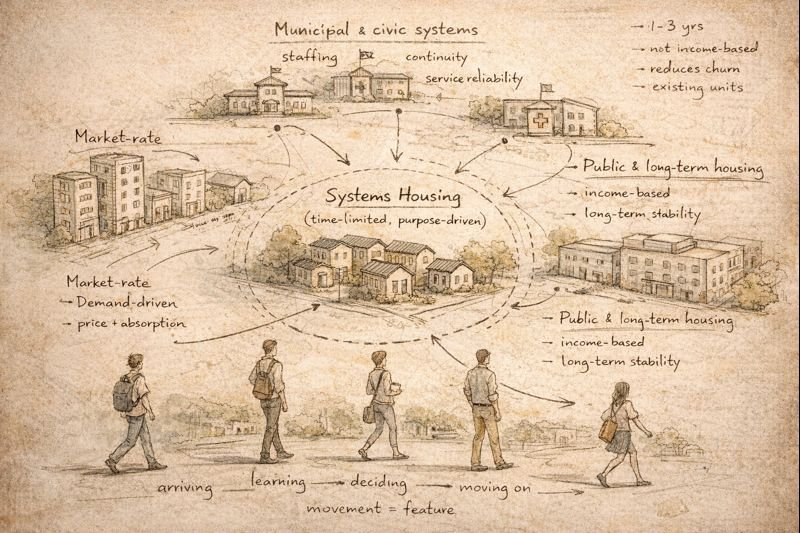
An expansion of housing tools within a community that complements subsidized housing tools, by deliberately positioning housing as infrastructure investments, to staff, stabilize, and sustain essential civic, public, and community-priority system team members.
A key clarification (this matters)
Systems Housing does not require building special or separate housing, it can of course include new units, but must work with exiting market.
In most cases, these units already exist, or are already being built.
Systems Housing works by aligning existing development with system needs.
That alignment can include:
participation from market-rate and affordable developers
threshold set-asides or unit commitments
bonus incentives or zoning flexibility
rent guarantees or master leasing
PBV-style certainty that reduces developer risk
From the developer’s perspective, this looks familiar: predictable rents, lower vacancy risk, faster absorption.
From the resident’s perspective, housing feels accessible, sometimes deeply affordable.
But from the system’s perspective, this is not a subsidy to a person, nor one tied to AMI constraints.
It is an infrastructure investment.
The unit is serving a function inside the system.
Purpose, not income
Access to Systems Housing is not primarily about income.
It’s about purpose.
People are selected because of the civic or community-serving roles they are stepping into or preparing for:
teachers
electricians
lineworkers
nurses
utility operators
public administrators
other public- and community-facing roles
This is how the military treats housing in the US, not as charity, but as mission-critical infrastructure.
Systems Housing applies that same logic to civilian civic life and community development strategies.
A very human example
Say a community realizes it needs electricians. And I hear this one a bit.
Not someday.
Now.
The work is there. The infrastructure depends on it.
So the community partners with institutions in the existing system, such as the IBEW. Training is visible and supported. And Systems Housing units, already part of existing developments, are made available.
Not forever.
Not randomly.
With intention.
Now a young person doesn’t just see a job posting.
They see a path:
training
housing
stability
people who know your name
That’s what many young people are actually leaving to find.
Systems Housing lowers the fear at the moment it matters most.
It doesn’t say stay forever.
It says jump in here.
Time-limited by design
Systems Housing is typically time-limited, often one to three years.
Long enough to arrive.
Long enough to learn.
Long enough to decide what comes next.
After that, people move on, or stay, without being trapped.
Movement is the feature, not the failure.
Scale belongs to the community
The scale of Systems Housing is not fixed.
Some communities may only need a handful of units. Others may choose to invest more heavily. That choice belongs to the community because the goal isn’t a number, it’s function.
This is about maximizing and aligning dollars already being spent.
Which brings us to budgets.
The part we usually avoid and where most community dreams die.
Systems Housing only works if this portion of the existing housing ecosystem, is treated as part of the systems that depend on people:
schools
healthcare
public safety
utilities
local government
Not because housing is their job, but because instability already shows up in their budgets as churn, vacancies, overtime, and constant restart.
Systems Housing doesn’t add a new cost.
It reorganizes an existing one.
What changes when this layer exists
When Systems Housing is in place:
civic and public service roles are supported structurally
young people try without fear
returning home becomes realistic
developers gain certainty
budgets reinforce each other
housing does more than one job
Public housing and LIHTC continue their essential long-term work. Market-rate housing continues to matter.
Systems Housing doesn’t replace any of that.
It fills a missing layer.
And when that layer exists, “where did everyone go?” stops sounding like a mystery, and starts sounding like a design problem we finally know how to solve.
That’s the idea behind Systems Housing.
Thank you for reading and for the great work you are doing in your own community.
This codex, is part of a larger work that will be embodied in my first text which is seeking to help move all our communities forward together.
The Garden Regions of Tomorrow: Reviving our Civic Imagination, is scheduled for released June 1, 2026.