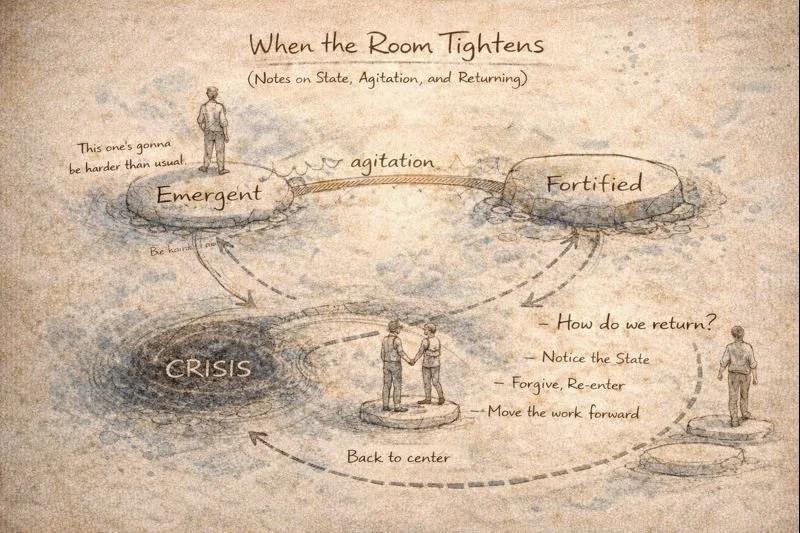
When the Room Tightens
(Notes on State, Agitation, and Returning)
Man, We’ve all been there.
That moment when you walk into a room and you can feel it, way before anyone says a word. Its almost like time slows down. Nothing has happened yet. No sharp exchange. No visible conflict. And still, your body knows.
This one’s gonna be harder than usual.
It’s not fear. It’s not even anticipation. It’s a subtle tightening. A density in the air. Like the room itself has already leaned forward.
Everyone knows this feeling. We just rarely name it.
I have come to understand that, States arrives way before words.
It enters fixed on every being and partnership cluster who enters a room, whether they choose to speak or not.
Looking back on last week’s meeting, that stayed with me long after it ended, I don’t think what mattered most was anything that was said. I mean, it was rough, lots of things said that sting even weeks later, and I did my share of agitation and word vomit.
If this feels familiar, or if you happen to be living it right now, try not to worry, and please don’t beat yourself up like I have all week.
These meetings matter, the words spoken are essential, however, the real work in community building is to understand what States of Us, were/are present during and after the exchange.
What I have come to learn is that the State of Us fluctuates throughout the day and varies by environment.
Individuals have States. Rooms have states. Partnership clusters have states.
These universal states emerge between us, through posture, pacing, silence, tone, history. Once a state is present, it shapes everything that follows: how comments land, how pauses are interpreted, how quickly things escalate or stall.
This isn’t psychology.
It’s physics.
From Generative to Crisis
I seem to spend a lot of time in the exhausting Generative state, by default. That’s where I do my best work, curious, exploratory, building outward with others.
But this room didn’t offer much to imagination, and at a certain point thats was true from both sides.
My system adapted. Not into collapse, I have done this too long. I moved directly into the Crisis state.
The Crisis state, I like to call the battle state, it is a type of holding state. It narrows focus and fortifies attention, not to win, but to stabilize. It shows up when stakes feel high and responsibility feels real. It’s less about persuasion and more about keeping the work from slipping.
States have both positives and negatives depending on our environments.
It is not always dramatic.
It’s not always precise. But it is Contained.
And in the case of the Crisis/Battle state, we are braced and fortified.
The Crisis state is expensive. As of now, I feel it may be the most taxing of all six states, as its effects stay with you “for a minute”. This is 90’s US semi hood slang for, an overly long duration of time. : )
Agitation as Movement
Here’s something I didn’t fully understand until this year:
There are three methods of state exchange I have identified, Agitation, Stimulation, and Attenuation. Energy moves and really doesn't stop.
Now here is hard part, Agitation isn’t harm. It’s a form of stimulation. It’s contact. It’s friction revealing where things are tight, misaligned, or unresolved. In living systems, Agitation often precedes change.
We tend to treat these moments as failures of professionalism or communication. We call them interpersonal issues and move on. And way too many times these misspoken or misinterpreted words, Fortify Us and eventually this individual Fortified state, is anchored and institutionalized to our partnership cluster and thus so too the programs and initiatives of the community.
Meanwhile, we’re trying to coordinate institutions. Build housing. Align systems with real human consequences.
The truth is quieter and harder:
You can have excellent policy, strong institutions, and clean processes, and still experience jams, if the human energy inside the system has nowhere to go.
Why Blame Doesn’t Help
It’s tempting, in moments like these, to replay the meeting looking for fault. Who started it. Who misread whom. Who brought what into the room.
That instinct is understandable.
It’s also unhelpful. Highly unhelpful. Blame is the ultimate enemy to our work!
Blame freezes the system. It locks attention backward. It turns a living interaction into a static story.
What actually helps is something simpler and more demanding:
State awareness without judgment.
What state was present?
What did it do to the room?
What did it cost?
And, most importantly, how do we return?
The Work Happens After
Here’s the part we don’t design for nearly enough:
You cannot control the State of any individual human. At the individual level we never truly know what someone is thinking feeling and carrying with them.
States arise. They take the wheel.
The ethical work happens after. After the meeting. After the Fortification.
After the agitation has done its work.
Can we notice the state we were in without shaming it?
Can we forgive ourselves and each other for being human under pressure?
Can we re-enter the work without pretending nothing happened?
If systems require perfect performance, they will fail.
If partnerships can’t survive a hard meeting, they won’t survive real work.
A Note for the Larger Theory
We’ve misdiagnosed the housing crisis, not because units and policy don’t matter (they do, deeply), but because we’ve left people out of the original equation.
Not people as numbers.
People as states.
Imagination doesn’t enter systems through spreadsheets alone. It enters through humans who feel safe enough, steady enough, and seen enough to stay engaged, even after tension.
The work of a Revitalist isn’t to control rooms or manage personalities.
It’s to cultivate conditions where return is possible.
Notes from the Field
That meeting didn’t resolve everything. It also didn’t break anything. What it did was reveal something real about how systems move, and how they stall.
Sometimes the work isn’t about smoothing the surface. Sometimes it’s about letting the water churn long enough to find a new channel.
No blame. No villains.
Just weather, movement, and the ongoing practice of coming back together.
That’s the work.
Thank you for reading and for the great work you are doing in your own community.
This codex, is part of a larger work that will be embodied in my first text which is seeking to help move all our communities forward together.
The Garden Regions of Tomorrow: Reviving our Civic Imagination, is scheduled for released June 1, 2027.